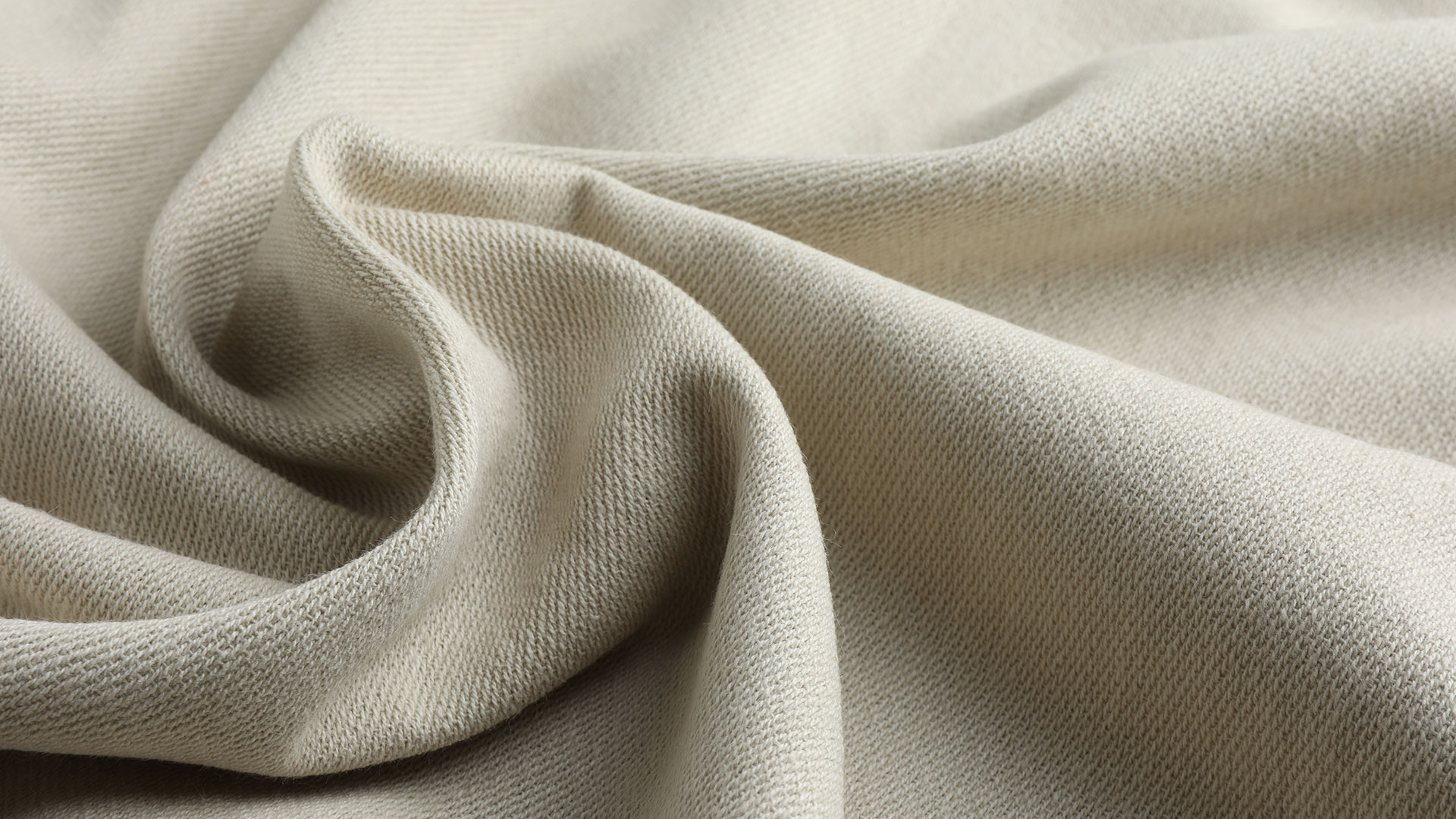

Used in apparel, home textiles & garment accessories.
Dedicated to in-depth expertise and continuous innovation in knitted textiles.
Content
If you need a knit that holds its shape without feeling stiff, start your shortlist with air-layer fabric and ponte roma fabric. Air-Layer Fabric has a spongy, slightly springy body that resists creasing, which is why it appears in hoodies, sweatshirt dresses and structured loungewear. Ponte Roma Fabric is flatter and firmer, which is why tailored trousers, skirts and knit blazers rely on it. Both belong to the wider double-knit fabric family, and both are produced in volume by an experienced knit fabric manufacturer in Keqiao.
Most enquiries that reach a knit fabric supplier start with a garment problem, not a fabric name. A brand wants a sweatshirt that does not bag out at the elbows after a week of wear. A womenswear buyer wants a dress that skims the body instead of clinging to it. A sportswear label wants a polo that stays crisp after repeated washing. Each of these problems points to a different structure, and the wrong choice usually shows up late, at fitting or after the first wash, when changes are costly.
This guide is written for buyers, designers and sourcing teams who work with a knit fabric wholesaler or factory and want to talk about fabric in practical terms. It covers the common air-layer blends, how ponte roma and interlock differ, where rib knit, single jersey, pique, waffle, terry cloth, crepe, fleece and mesh each earn their place, how to compare them side by side, and how to look after the finished fabric. Where numbers appear, they are typical sourcing ranges or indicative comparisons, not test results, and final specifications are confirmed on a sample.
Short answer: choose air-layer for body and wrinkle resistance, ponte roma for a tailored line, interlock for smooth skin contact, and the lighter structures for specific surface or breathability needs.
Air-Layer Fabric is sometimes sold under names such as space-layer, bubble-layer or air cotton knit, and the terms are not standardised between mills. What they share is a three-part build: a face layer, a back layer, and a lightly tucked middle that keeps the two apart. The fiber blend then decides how the fabric feels, drapes and ages. The cards below summarise the five blends that Air-Layer buyers ask about most often.
Polyester-Viscose Air-Layer Knit Fabric
The everyday workhorse. Polyester supports shape and dimensional stability, viscose softens the hand and adds a cooler touch. Common in sweatshirts, dresses and loungewear sets. Tencel-Modal Air-Layer Knit Fabric
A cellulosic blend with a smooth, fluid surface and good moisture handling. Suited to premium loungewear, baby wear and garments worn close to the skin. Polyester-Tencel Air-Layer Knit Fabric
Polyester gives the structure, lyocell gives a cleaner, softer face. A practical step up from polyester-viscose when the surface feel matters to the buyer. Slub Air-Layer Knit Fabric
Uneven slub yarn creates a deliberate, casual texture on the face. Popular for relaxed tops and sweatshirts where a visibly natural look is part of the design. Polyester-Spandex Air-Layer Knit Fabric
A small amount of spandex adds recovery, so fitted silhouettes keep their lines at the knees, elbows and waist. Used for leggings, fitted tops and shaping garments.
Notice that the structure is constant while the yarn changes. That is useful when you plan a collection, because several blends can share the same weight class and hand direction, and the choice becomes a matter of feel, performance and positioning rather than a new development each time.
Air-layer blends differ mainly in surface feel and recovery, so decide your hand and performance targets before you decide the fiber.
The easiest way to understand air-layer is to picture a sandwich. The top slice is a smooth knit face, the bottom slice is a second knit, and the filling is a set of tucked yarns that hold the slices a small distance apart. That gap is what gives the fabric its cushioned, slightly bouncy feel, and it is also what makes the fabric resist creasing. A flat single layer folds and stays folded. A layered one pushes back.
The schematic below shows the three zones in simplified form. Real fabrics have loops and tuck points that are far smaller than the drawing suggests, but the proportions explain why the fabric behaves the way it does.
Simplified isometric view of an air-layer knit: face layer, air gap with tucked spacer yarns, and back layer.
The trade-off is weight and warmth. An air-layer knit holds more air and more yarn than a single jersey, so it suits cool to mild weather and indoor wear better than hot-climate summer garments. When a client needs the same look in a lighter format, a mesh or lightweight single jersey is usually the better direction.
The air gap is the whole story: it gives air-layer its body, its rebound and its wrinkle resistance, and also its extra weight.
Double-Knit Fabric is a broad label for knits made on two needle beds so that both faces look smooth and the fabric is thicker and more stable than single jersey. Ponte Roma and interlock are the two members buyers meet most often, and they are frequently confused. They look similar on the roll but behave differently once cut and sewn.
Ponte roma is a firm, close double-knit with a smooth face and a restrained stretch. It holds a crease line, resists bagging at the knee and sits well under a seam, which is why it dominates stretch trousers, pencil skirts, sheath dresses and knit jackets. Two blends appear constantly in sourcing briefs. TR Ponte Roma Fabric combines polyester and rayon (viscose): the polyester supplies stability, the rayon softens the hand. NR Ponte Roma Fabric combines nylon and rayon, and is chosen when a buyer wants a smoother, slightly silkier surface and a leaner drape.
Interlock is made of two interlocked 1x1 rib structures, giving a smooth face on both sides and good dimensional stability. It is lighter and softer than ponte roma, drapes more easily and does not curl at the edges. The fiber choice shapes the end use:
If the garment must hold an edge or a pleat, lean toward ponte roma. If it must feel smooth and flow with the body, lean toward interlock. If it needs a spongy body with a softer, more casual look, go back to air-layer.
Ponte roma builds structure, interlock builds smoothness, and the fiber blend inside each decides comfort and recovery.
Ribbed Fabric has alternating knit and purl columns that create vertical ridges and a pronounced stretch across the width. Rib Knit Fabric in 1x1 or 2x2 form is the standard choice for cuffs, collars, hems and body-hugging tops because it stretches readily and recovers well. Ribbed Fabric With Vertical Stripes goes a step further, using yarn or structure variation to make the ridges more visible, which suits fashion tees, knit dresses and lounge sets where the texture is part of the design.
Single Jersey is knitted on one needle bed, with smooth V-shaped stitches on the face and looped stitches on the back. It is light, soft and efficient to cut. Stretch Single Jersey includes spandex and suits fitted tees, leggings and tops that need recovery. Non-Stretch Single Jersey is a pure staple fabric for relaxed tees, pajamas and linings. Polyester Jersey Fabric is the moisture-managing, quick-drying choice for sportswear, uniforms and printed apparel. The main caution is edge curl, so cutting rooms often stabilise the lay with spreading tension control.
Pique Fabric has a raised geometric texture, often a small honeycomb or diamond, which gives the surface a dry, breathable hand. Single-Knit Pique is lighter and suits warm-weather polos and school wear. Double-Knit Pique is firmer, holds its shape better through collars and plackets, and carries a more premium look in uniforms and golf apparel. Because the texture hides small marks, pique is also forgiving in daily wear.
| Fabric | Main strength | Typical garments | Watch point |
|---|---|---|---|
| Rib knit | Width-wise stretch and recovery | Cuffs, collars, fitted tops | Shade and width consistency across lots |
| Single jersey | Lightweight softness | Tees, pajamas, base layers | Edge curl and twisting after wash |
| Single-knit pique | Textured, breathable surface | Polo shirts, school wear | Surface snagging on rough finishes |
| Double-knit pique | Shape retention | Uniforms, golf polos | Heavier hand, slower drying |
Rib handles fit, jersey handles comfort, and pique handles structure and texture at the neckline and chest.
These five groups are chosen less for general shape and more for a specific job: warmth, absorbency, softness, drape or ventilation. Understanding the job first prevents over-specifying.
Waffle Fabric has a grid of raised and recessed cells that trap air, which gives it a thermal feel at a modest weight and a recognisable surface for loungewear and thermal tops. Cotton Waffle Fabric is soft and absorbent, popular in robes and pajamas. CVC Waffle Fabric blends cotton-dominant fiber with polyester, which tends to improve shape retention and shrinkage control. 100% Polyester Waffle Fabric dries faster and keeps color well, so it is often used in activewear layers and thermal tops.
Terry Cloth Fabric forms loops on one or both sides, creating a moisture-absorbing surface. Knit terry, often called French terry when the loops are on the back, is the base of many sweatshirts and joggers. Looped terry on both sides appears in towelling, robes and some home textiles.
Fleece Fabric is brushed on one or both sides to raise a soft pile that traps warm air. It is used in jackets, hoodies, blankets and cold-weather linings. Ask for pilling and shedding data when the garment will be washed often.
Crepe Fabric has a fine, pebbly surface created by high-twist yarn or structure. It drapes fluidly, hides small marks and resists clinging, which makes crepe knit a regular in dresses, blouses and tailored womenswear.
Mesh Fabric is an open structure with visible holes that move air and moisture quickly. It appears in sports linings, athletic panels, bags and layered fashion pieces. The key checks are hole stability, snag resistance and the way the mesh sits against the skin.
Pick these fabrics for the job they do, whether warmth, absorbency, drape or ventilation, rather than by name alone.
Selection works best when it starts with the garment and the end customer, then narrows to structure, then to fiber. The two columns below separate the use cases from the checks that should accompany them.
Application scenarios
|
Selection checks
|
To see how these structures line up against the main garment categories, the next chart compares fit levels. It uses a qualitative scale based on typical construction behaviour, so treat it as a starting point for conversation with your fabric supplier.
Indicative fit of eight fabric families across five garment categories (qualitative, not test data).
Reading across the rows, interlock and air-layer show the broadest range, which explains why they are core items in many ranges from a knit fabric manufacturer. Ponte roma concentrates its strength in bottoms and jackets, where its stable hand matters most. Pique and rib sit comfortably in tops but are rarely the first choice for trousers or outerwear. Waffle and fleece are specialists for loungewear and cold-weather pieces. The practical conclusion is that a small, well-chosen core range, supported by a few specialist structures, usually covers more garment types than a long list of single-purpose fabrics, and it makes reordering simpler for both the brand and the factory.
A compact core of air-layer, interlock and ponte roma, plus two or three specialist knits, covers most garment categories.
The table below puts the main structures side by side. It is written in plain language so that designers, merchandisers and buyers can use it in a meeting without a technical glossary.
| Fabric | Hand and body | Stretch and recovery | Typical use | Watch point |
|---|---|---|---|---|
| Air-layer | Spongy, springy, medium to heavy | Moderate, improves with spandex | Hoodies, dresses, loungewear | Surface tuck marks, weight drift |
| Ponte roma | Firm, smooth, crisp | Controlled, good recovery with spandex | Trousers, skirts, jackets | Heavier drape, seam puckering |
| Interlock | Smooth, soft, even | Good, especially with spandex | Tees, activewear, baby wear | Snagging on rough handling |
| Rib knit | Ridged, elastic | High across the width | Cuffs, collars, fitted tops | Width variation between lots |
| Single jersey | Light, soft | Low to moderate | Tees, pajamas | Edge curl, twisting |
| Pique | Textured, dry | Low to moderate | Polos, uniforms | Surface snags |
| Waffle | Thermal, grid texture | Low to moderate | Loungewear, thermal tops | Depth of cells, shrinkage |
| Terry cloth | Looped, absorbent | Low | Sweatshirts, robes, towelling | Loop snagging, drying time |
| Fleece | Brushed, warm, soft | Low to moderate | Jackets, blankets | Pilling and shedding |
| Crepe | Pebbly, fluid | Moderate | Dresses, blouses | Surface uniformity |
| Mesh | Open, light | Moderate | Sports panels, linings | Hole stability, snagging |
To make the first three families easier to compare, the radar chart below scores air-layer, ponte roma and interlock on five qualities. Each score is an indicative rating for a typical medium-weight fabric, not a laboratory measurement. The goal is to show shape, not precision.
Indicative comparison on a five-point scale for a typical medium-weight fabric of each type.
The air-layer shape bulges toward structure and warmth, which matches its spongy, cushioned character. Ponte roma extends furthest on structure and pulls inward on drape and breathability, confirming that it is the firmest and most tailored of the three. Interlock covers the widest area on drape and stretch recovery, so it is the more flexible choice when a garment must move with the body. None of the shapes dominates the others, which is precisely why buyers ask for sample swatches of all three before fixing a direction. If a design calls for a soft but stable pullover, air-layer is usually the starting point. If it calls for a pair of trousers that hold a crease, ponte roma moves to the front. If it calls for a fitted performance top, interlock with spandex becomes the logical candidate.
Fiber blend is the second variable after structure, and it is easy to underestimate. The next chart shows typical blend ratios seen in sourcing briefs for six common fabrics. The ratios are illustrative, and the final composition is set per order against a target hand and performance.
Illustrative blend ratios seen in sourcing briefs; final ratios are agreed per order.
The three interlock bars show how little spandex is needed to change behaviour: a small share, often in the range of five to ten percent, is enough to add recovery without turning the fabric into a compression material. Nylon-spandex interlock carries the largest elastane share, which matches its use in close-fitting performance garments. TR ponte roma and polyester-viscose air-layer both lean on polyester as the structural fiber, with viscose providing softness. This is why the two fabrics feel similar in the hand even though their structures differ. For a brand, the practical lesson is to describe the garment performance first and let the mill propose the blend, then confirm it with a physical sample and a wash test before bulk production.
Structure sets the shape of the fabric, but the fiber blend sets how it feels, how it recovers and how it ages.
The company focuses on knitted textiles, mainly engaged in the production, processing and raw material sales of a wide range of knitted fabrics. As a reliable manufacturer and factory of sustainable knitted fabrics, it also offers OEKO-TEX certified fabric options for buyers who need them for their markets. The products are used in clothing, home textiles, clothing accessories and related applications.
Located in the industrial cluster around Shaoxing Keqiao China Light Textile City, the company gives customers stable access to textile raw materials and finished fabric supply. For a buyer, a cluster location matters in practical ways. Yarn, dyeing, finishing and trims are close by, which shortens sampling loops and makes it easier to adjust a spec after a fitting. It also helps when a collection needs several fabric families, such as air-layer, ponte roma and interlock, coordinated in matching shades.
Buyers who work with a knit fabric wholesaler on repeat programs often find that the most useful habit is keeping an approved reference swatch for every qualified fabric. Mills change yarn lots, machine settings drift and seasons shift. A physical reference gives both sides a clear baseline when a lot is questioned.
A clear brief, a retained reference sample and written tolerances do more for consistency than any single technical feature.
Most problems with knit fabric orders trace back to a handful of repeat patterns. None of them is dramatic on its own, but together they explain why two orders that looked identical on paper arrive with different hands, different shrinkage or different shades. Knowing the patterns in advance lets a buyer ask better questions at the sampling stage.
Names such as air-layer, ponte or space knit are used loosely across the market. Two mills can sell something under the same name with a different weight, a different yarn count and a different hand. Describing the garment, the weight range, the stretch target and the care expectation gives the mill something measurable to work toward, and it makes sample comparison fairer.
A handloom swatch shows color and general hand, but it does not show how a full roll behaves under tension, in dyeing or after finishing. Whenever the schedule allows, approve a sample yardage that has gone through the same dyeing and finishing route as bulk. This is especially relevant for polyester-viscose and Tencel-Modal air-layer blends, where finishing has a visible effect on surface softness.
Stretch Single Jersey, polyester-spandex interlock and polyester-spandex air-layer can look and feel similar in the hand while recovering very differently after repeated wear. Ask for the spandex share and for a stretch and recovery check in both directions, then test a finished garment, not just the fabric on its own.
Rib, jersey and pique that are meant to match, for example a rib collar on a pique body, are often dyed in separate lots. Small shade differences appear when a cuff and a body come from different batches. A shade plan that groups matching fabrics in the same dye run, or that clearly specifies acceptable variation, avoids rework later.
Waffle, terry, fleece and crepe change character after washing: cells deepen, pile settles, surface relaxes. Judging them only in the dry, flat state can mislead. A simple wash and dry cycle on the sample, followed by a measurement and a visual check, tells you more about the final garment than any specification sheet.
Most knit sourcing problems are preventable with a clear brief, a finished-route sample and one wash test before cutting.
Good care protects shape, color and surface. The advice below applies to most garments made from the fabrics in this guide, but the care label on the finished garment should take priority.
| Fabric group | Washing | Drying | Extra tip |
|---|---|---|---|
| Air-layer and ponte roma | Cool to warm, gentle cycle | Low heat or flat dry | Avoid hot irons to protect the surface |
| Interlock with spandex | Cool wash, mild detergent | Low heat, avoid overdrying | Skip fabric softener on performance wear |
| Rib, jersey and pique | Cool to warm wash | Low heat or line dry | Turn inside out to limit surface wear |
| Waffle, terry and fleece | Cool wash, wash separately | Low heat | Avoid contact with hook fasteners |
| Crepe and mesh | Gentle cycle or mesh bag | Flat or line dry | Avoid wringing to protect the structure |
For bulk orders, a practical step is to include a care-label test in the sample stage, washing a finished sample garment several times and measuring length and width change. This catches problems early, before a shipment is already on its way to the customer.
Cool washing, low heat and gentle handling extend the life of nearly every knit fabric in this guide.
What is air-layer fabric, and how is it different from ponte roma fabric?Air-Layer Fabric is a layered knit with a lightly tucked middle that creates a spongy, springy body and good wrinkle resistance. Ponte Roma Fabric is a firm, close double-knit with a smooth face and a crisp, tailored hand. Air-layer suits relaxed, cushioned garments, while ponte roma suits trousers, skirts and fitted dresses. |
Which air-layer blend should I choose for loungewear?Tencel-Modal Air-Layer Knit Fabric and Polyester-Tencel Air-Layer Knit Fabric give a softer, cooler face for skin-contact pieces. Polyester-Viscose Air-Layer Knit Fabric is a practical all-round option, and Polyester-Spandex Air-Layer Knit Fabric suits fitted silhouettes. Ask for physical swatches, because handfeel is easier to judge by touch than by description. |
What is the difference between TR ponte roma and NR ponte roma?TR Ponte Roma Fabric combines polyester and rayon, giving stability and a soft hand for trousers and skirts. NR Ponte Roma Fabric combines nylon and rayon, which tends to give a smoother surface and a leaner drape. Your garment type, drape target and care requirements decide which one fits. |
When should I use interlock instead of single jersey?Interlock is heavier, smoother on both faces and does not curl at the edges, so it suits garments that need a clean finish and a bit more body. Single Jersey is lighter and quicker to cut, making it well suited to tees and base layers. Stretch Single Jersey and Non-Stretch Single Jersey are both available for different fit needs. |
Is waffle fabric only for winter garments?No. Cotton Waffle Fabric and CVC Waffle Fabric are popular in robes, pajamas and loungewear across seasons, while 100% Polyester Waffle Fabric is used in lighter thermal and activewear layers. The grid texture traps air, so warmth depends on the fiber and the weight chosen. |
What information should I send a knit fabric supplier for a quote or sample?Send the garment type, target weight range, preferred fiber blend, stretch requirement, target colors and estimated volume. It also helps to share a reference swatch or garment if you have one. With that information a knit fabric manufacturer can recommend a structure and propose samples more quickly. |
When in doubt, describe the garment and its performance, then let sample swatches settle the fabric choice.
To browse air-layer, ponte roma, interlock, rib, jersey, pique, waffle, terry, crepe, fleece and mesh fabrics, or to request sample swatches, visit the manufacturer website: Knitted Fabric Manufacturer and Supplier.
 Related Products

Dedicated to in-depth expertise and continuous innovation in knitted textiles.
Quick Links
Products
Contact Us
Tel: (86)-15988227526
Tel: (86)-15005858876
E-mail: peng@maozante.com
Add: 2nd Floor, Building 2, Baiyang Village, Anchang Street, Keqiao District, Shaoxing City, Zhejiang Province