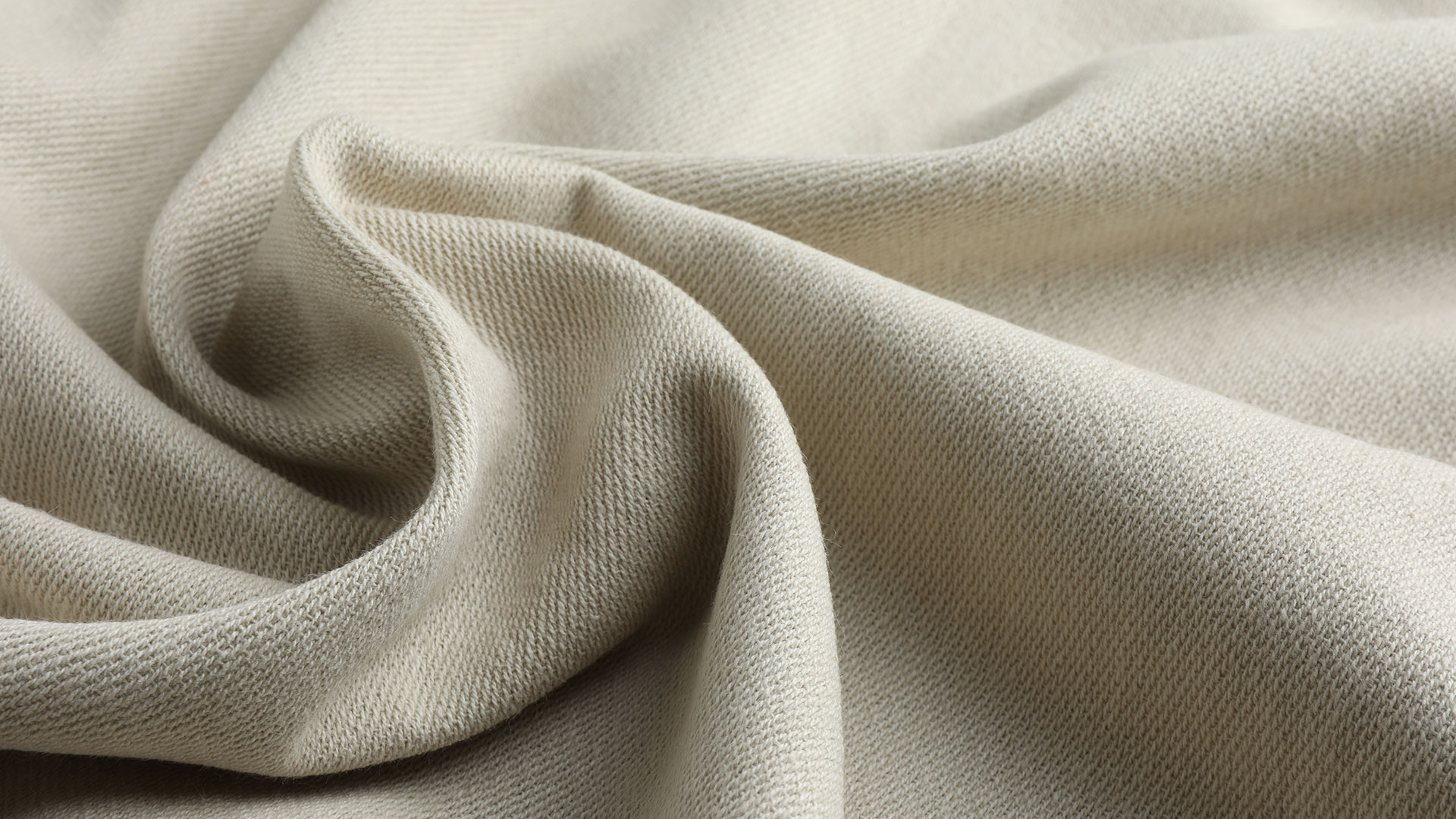
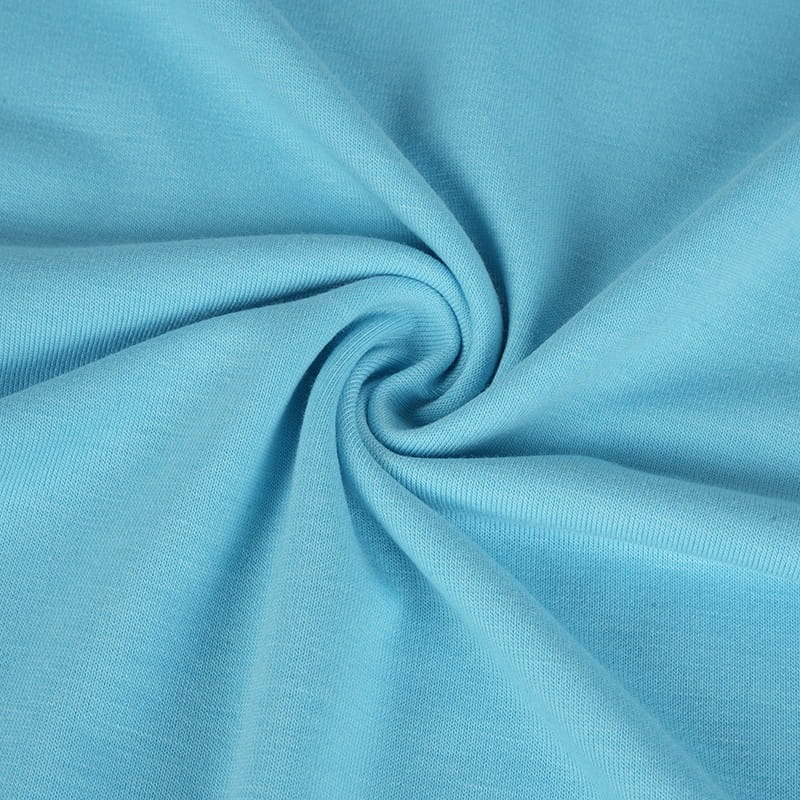
Polyester Jersey Fabric from Our Keqiao Knitting Mill
Maozan Textile operates as a Polyester Jersey Fabric Supplier from Keqiao, Shaoxing, inside the mill district that surrounds China Light & Textile Industry City. We knit, dye, finish and supply polyester single jersey for T-shirt, sportswear, uniform, innerwear, casualwear and home textile programmes, and we develop OEM/ODM variants where a defined hand, weight and color matter more than a catalogue reference.
Our polyester jersey is produced on single jersey circular knitting machines from polyester filament or spun yarn, giving a smooth technical face, a fine loop reverse and a dimensionally stable structure that holds its appearance through repeated washing and long service. Because the loop structure itself supplies crosswise stretch, the fabric can be supplied with or without elastane depending on how much recovery the garment needs.
Typical performance profile: stable structure, quick drying, low shrinkage under correct finishing, easy-care washing behaviour, abrasion and wear resistance, and a printable flat surface.
- Smooth face for printing, sublimation and clean topstitching
- Controlled spirality and course/wale balance for cut-and-sew panels
- Consistent width and weight run to run, supporting repeat orders
- Yarn, weight, color and finishing confirmed against the end use
Our Knitted Fabric Range and Application Fit
Polyester single jersey sits within a wider knitted programme we run as a specialist mill. The table below shows how the groups relate, so a buyer building one collection can source body fabric, trims and accent qualities from a single supply chain.
| Fabric group |
Knit structure |
Typical application fit |
| Polyester Jersey Fabric |
Single-face jersey loops |
T-shirts, sportswear, uniforms, innerwear, print bases |
| Stretch Single Jersey |
Jersey loops with elastane |
Fitted tops, leggings, activewear, shaping garments |
| Non-Stretch Single Jersey |
Jersey loops, no elastane |
Casualwear, print panels, linings, accessories |
| Pique Fabric |
Cellular pique surface |
Polo shirts, sports jerseys, schoolwear |
| Double-Knit and Interlock |
Two interlocked faces |
Structured tops, dresses, kidswear, heavier shirting |
| Ribbed Fabric |
Vertical rib columns |
Cuffs, neckbands, trims, fitted body panels |
| Air-Layer Fabric |
Two faces joined by spacer yarn |
Outerwear, sportswear, home textiles, structured panels |
| Waffle, Terry Cloth, Crepe |
Raised grid, loop pile, pebbled surface |
Robes, towelling, loungewear, blouses, dresses, home textiles |
Polyester jersey remains the volume base of the programme because it prints cleanly, dyes consistently and travels well across mixed export containers. Where a collection needs a softer drape, we can quote the same construction in viscose, Tencel or blended yarns from our knitted range.
Configuring Polyester Jersey for a Programme
Single jersey is a simple structure and a demanding one at production scale. Weight, width, yarn lot and finishing route all interact, so we confirm the working point before sampling rather than after bulk knitting.
- Yarn: filament (FDY/DTY) for a cleaner surface and brighter print, spun polyester for a drier, more matte hand; count and interlacement set the drape and cover.
- Weight and width: light to mid apparel weights are the common commercial band for T-shirt and sportswear programmes; heavier versions suit uniforms and outer layers. We confirm tubular or open-width, slit and heat-set options against your cutting room.
- Elastane content: added when recovery, fit retention or a compact hand is required; omitted where the garment is printed flat or the fabric must stay fully dimensionally rigid.
- Color: dyed to lab dip against your Pantone, TCX or physical standard, with lot approval before bulk dyeing.
- Finishing: moisture-wicking, anti-static, anti-pill and softening finishes, plus printing or brushing where the end product calls for them.
- Packing: roll length, tube or flat fold, inner poly bag and shipping marks set to the destination warehouse.
Where Polyester Jersey Fits in Production
The fabric is used across apparel, home textiles and garment accessories. Its dimensional stability, quick-drying behaviour and easy-care washing make it a practical choice wherever print registration, colour consistency and repeat order accuracy drive the cost of the garment.
- T-shirts and casual tops: flat printable surface, stable panel size, clean overlock and twin-needle behaviour.
- Sportswear and innerwear: moisture transport, low cling, and controlled stretch where elastane is included.
- Uniforms and workwear: abrasion resistance and shape retention after industrial laundering cycles.
- Home textiles and accessories: linings, bag bodies, neckbands, bindings and trim strips cut from the same dye lot.
Quality Control, Testing and Acceptance
We are a knitted fabric manufacturer running full-process quality management: inspection follows each production step, and finished rolls receive final inspection against customer requirements and international standards in our testing laboratory. OEKO-TEX certified options are available across the knitted range for programmes with restricted-substance requirements.
- Greige and finished weight, width and course/wale checks
- Colour approval by lab dip, then bulk lot verification against the sealed standard
- Shrinkage, spirality and appearance-after-wash assessment
- Colourfastness to washing, rubbing and light where the end use demands it
- Pilling, pH and dimensional recovery checks
- Final roll inspection with defect marking, length and packing verification
Where a customer nominates a third-party test package or a buying-office inspection, we knit and finish to that agreed specification and schedule the inspection before shipment.
Information We Use to Configure Your Solution
A quotation is only useful if the specification behind it is fixed. Below is the information we work from when preparing a polyester jersey proposal, sampling plan and price.
| Project input |
What we need |
How it shapes the specification |
| End product |
Garment type, panel list, cut method |
Sets stretch, stability and width format |
| Weight and width |
Target GSM and usable width, tolerance |
Determines yarn count, gauge and finishing |
| Yarn and composition |
Filament or spun, blend ratio, elastane percentage |
Controls hand, cost and recovery |
| Colour |
Pantone/TCX or physical standard, colour count |
Drives dyeing route and lot planning |
| Hand and finishing |
Softness, wicking, anti-static, print or brush |
Selects finishing sequence and equipment |
| Acceptance |
Test package, standard, inspection point |
Defines final inspection and documentation |
| Logistics |
Roll length, packing, marks, destination, repeat plan |
Shapes packing line and shipping documents |
Sampling, Reorders and Supply Support
We work with flexible cooperation models rather than a single fixed order shape. Small-batch sampling and quick reorders are part of normal operation, supported by OEM/ODM development where a customer brings a target specification, a reference garment or a colour standard.
- Development sampling with retained colour and construction records
- Repeat production against the approved standard for continuity across seasons
- Raw material and finished product supply through the Keqiao cluster for short lead-time changes
- Enquiries answered within 12 hours on weekdays, with technical questions routed to production
Polyester Jersey Fabric: Common Project Questions
What is polyester jersey fabric mainly used for?
It is a single-face knit used for T-shirts, sportswear, casual garments, innerwear, uniforms and other knitted apparel, as well as garment accessories and home textile items. It prints cleanly, dyes consistently and holds panel shape through washing.
Can weight, width, colour and finishing be customised?
Yes. Yarn specification, weight, width, colour and finishing are set per programme. Moisture-wicking finishing, anti-static treatment, dyeing and printing are applied where the end product requires them.
Do you supply OEKO-TEX certified polyester jersey?
OEKO-TEX certified options are available within our knitted fabric range. The applicable certificate is confirmed for the specific yarn, dye and finishing route used on your order before bulk production begins.
How does sampling and reordering work?
We sample against a defined weight, width, colour and hand standard, keep the approved reference on record, and produce repeat orders to that same reference. Small-batch sampling and quick reorders are handled as part of our normal production flow.
How is quality checked before shipment?
Inspection follows each production stage, and finished fabric is finally inspected to the agreed customer requirement and international standards in our testing laboratory. Weight, width, colour, shrinkage and appearance checks are recorded, and third-party or buying-office inspection can be scheduled against the nominated standard.
Related Products and Categories
Our portfolio also includes Product for applications with different operating ranges, interfaces or integration requirements.