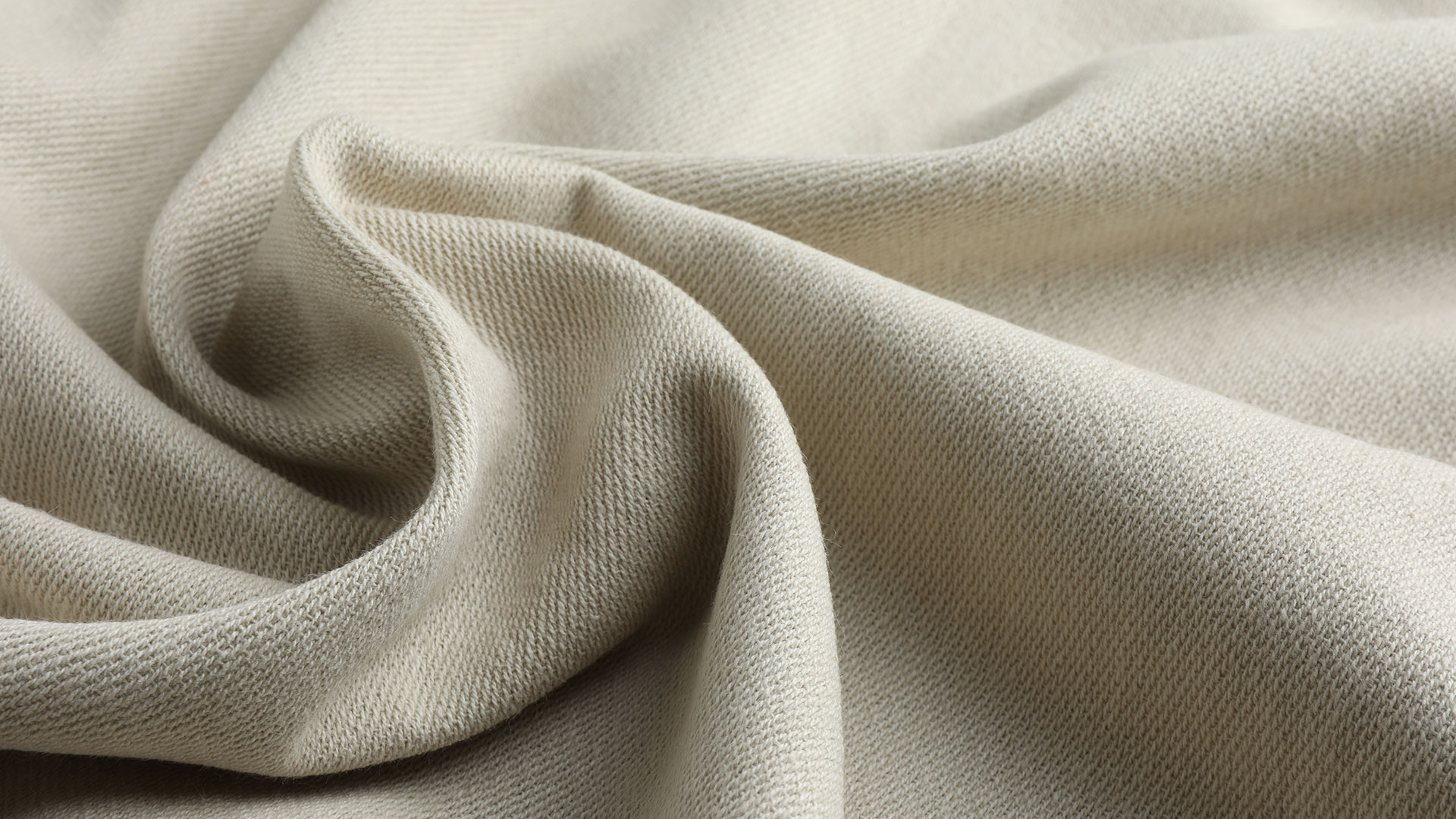
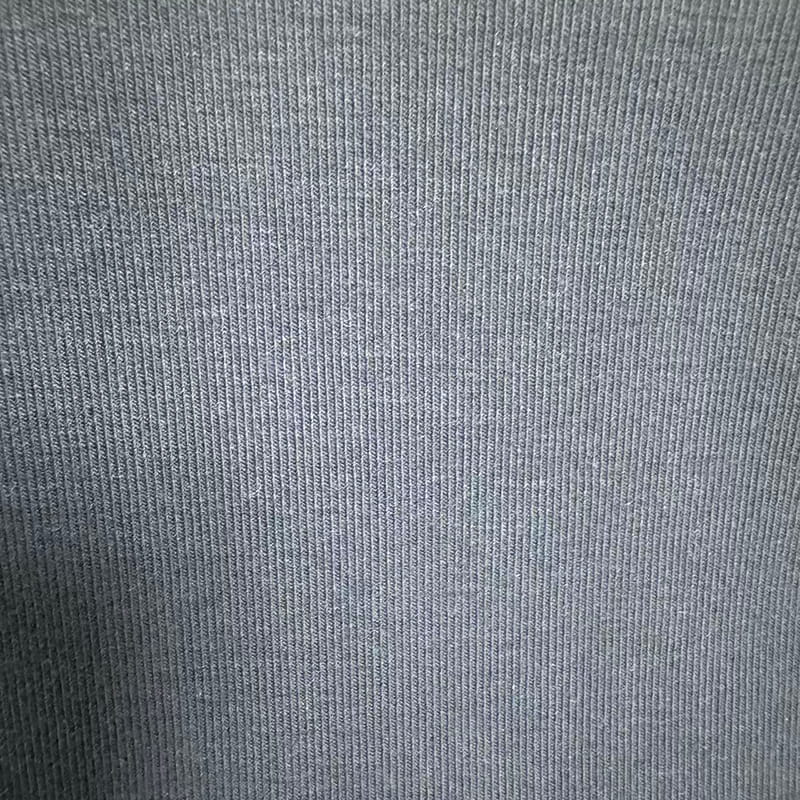
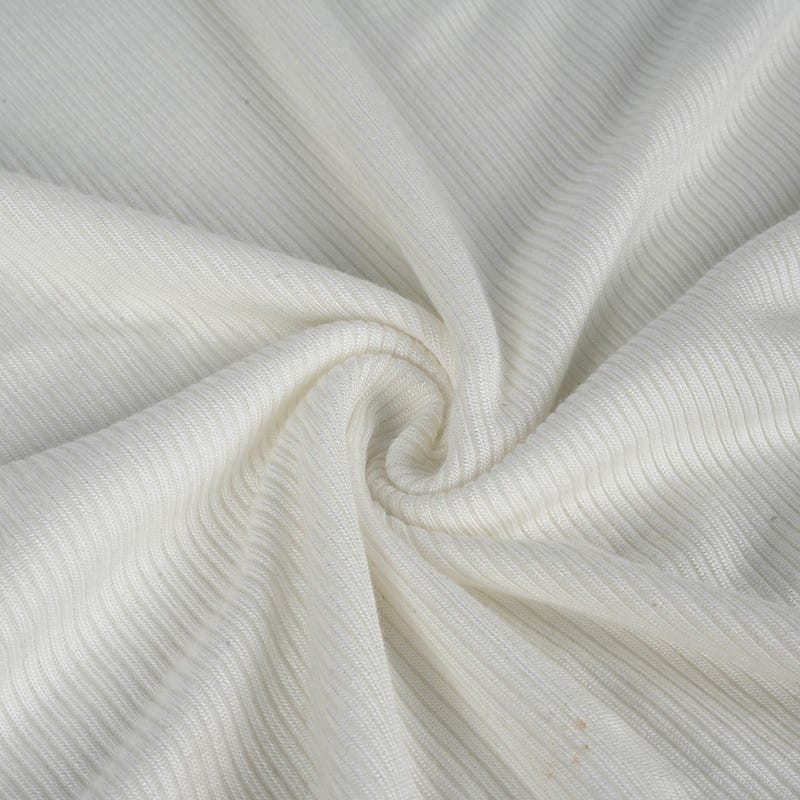
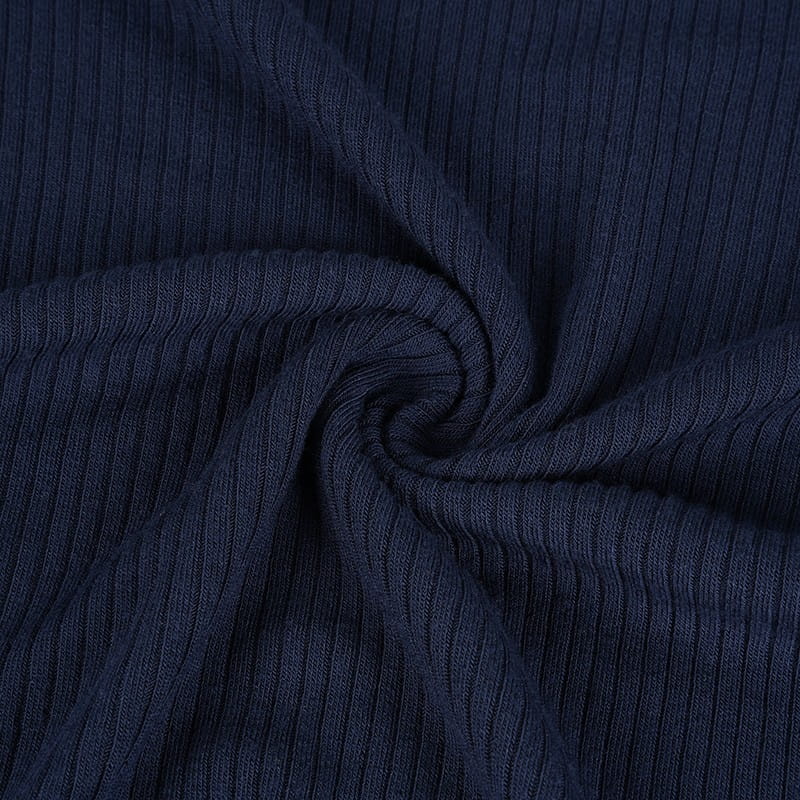
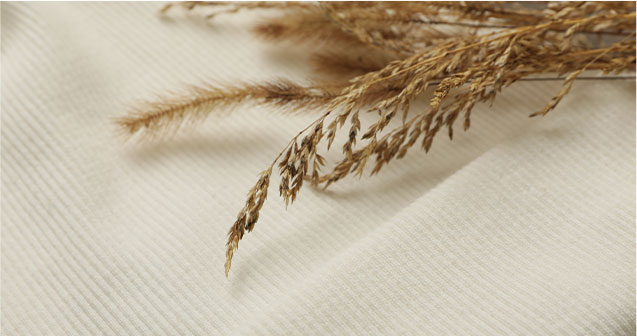
Shaoxing Keqiao Maozan Textile Co., Ltd. is a Wholesale Stretch Rib Fabric Supplier serving apparel brands, garment accessory producers, converters and home textile buyers. We knit, process and supply rib knit fabric with controlled stretch, stable recovery and repeatable shade, backed by OEKO-TEX certified options and flexible ODM/OEM cooperation.
Our operations sit in Keqiao, Shaoxing, beside China Light & Textile Industry City, which keeps yarn sourcing, knitting, finishing and shipping on a short, well-connected chain.
Rib Knit Structures We Knit and Where Each One Fits
Rib knit is built from alternating knit and purl wales, so the fabric carries visible longitudinal lines, high cross-wise extension and the ability to pull back to shape. The wale geometry decides how the fabric behaves on the body and how it reads visually on a garment.
1×1 fine rib
Smooth, dense surface with soft hand feel — the choice for close-fitting layers and narrow trim where bulk must stay low.
2×2 medium rib
Fuller hand and clearer three-dimensional wales — used for cuffs, collars, hems, slim knitwear and children's wear bands.
4×2 and wider ribs
Pronounced ridge and more body — suits statement trims, waistbands and heavier knitwear silhouettes.
Striped and colour-blocked rib
Ribbed Fabric With Vertical Stripes for panels and trims that need vertical colour movement on top of stretch.
| Construction |
Surface character |
Typical weight band (confirmed at sampling) |
Where we position it |
| 1×1 rib |
Fine, uniform wales, smooth face |
approximately 120–220 g/m² |
Underwear, base layer shirts, vests, T-shirt bodies, narrow neckline and cuff tape |
| 2×2 rib |
Wider wales, fuller hand, visible relief |
approximately 200–320 g/m² |
Cuffs, collars, hem bands, slim knitwear, home clothes, children's wear |
| 4×2 rib |
Pronounced ridge, substantial body |
approximately 260–380 g/m² |
Outer knitwear trims, chunky cuffs and waistbands, design-led panels |
| 4×3 and wider ribs |
Broad wale spacing, maximum visual relief |
approximately 280–420 g/m² |
Statement trims, waistbands, structured knitwear panels |
| Striped / colour-blocked rib |
Rib wales plus vertical stripe effect |
matched to the base construction |
Trims and panels with vertical colour blocking |
Fibre Bases, Hand Feel and Elastic Performance
Ribbed stretch fabrics in our range include 1×1 cotton-spandex stretch, 2×2 modal ribbed stretch and 4×2 modal ribbed stretch, alongside Lenzing™ viscose striped rib qualities. Fibre choice drives three things at once: skin comfort, drape, and how much the wale structure holds its shape after repeated wearing and washing.
- Cotton-spandex rib — breathable, matte and stable for base layers, vests and trim that touches skin.
- Modal rib — smoother face, softer drape and better colour depth for closer-fitting knitwear and premium trims.
- Viscose and Lenzing™ viscose rib — fluid hand and clean vertical stripe definition where a softer silhouette is required.
- Blend adjustments — spandex content and yarn count are set with the target extension and recovery, not chosen independently of the construction.
Body panels built to work under ribbed trims sit in our Double-Knit Fabric range, so collar, cuff and body fabric can be developed against the same shade and washing programme.
Application Fit Across Apparel and Home Textiles
Rib knit stretches with the body and returns to shape, which is why it carries both functional and decorative roles in the same garment. Fine ribs handle close-fitting programmes; wider ribs give volume and texture where a garment needs structure rather than compression.
- Underwear, base layer shirts, vests and T-shirt bodies in fine 1×1 constructions.
- Cuff, neckline and hem splicing that must match the body fabric in shade and after repeated wash.
- Slim knitted clothing, loungewear and home clothes where wrap and softness matter.
- Children's wear bands and cuffs where recovery after stretching is the main durability risk.
- Home textiles and garment accessories that use rib for edge finishing and elasticated openings.
Critical Specifications We Confirm Before Knitting
A rib development is only repeatable when the construction, relaxation state and finishing route are agreed together. We fix the following points on the technical sheet before bulk yarn is committed:
- Wale and course density, needle gauge and the wale ratio of the chosen rib.
- Fibre composition, spandex content and yarn count, with the recovery after repeated extension.
- Relaxed width after finishing, plus width tolerance across the roll.
- Weight per square metre measured in the agreed relaxed state.
- Shrinkage behaviour after wash and steam relaxation, so cut panels keep their size through the garment process.
- Shade continuity against the approved standard and colour fastness for the intended end use.
- Hand feel targets: softness, bulk, surface smoothness and stretch direction.
- Roll put-up, selvedge condition, roll diameter and packing format for the shipping route.
Processing, Inspection and Acceptance
We work to full-process quality management: inspection follows each production step, and finished rolls are examined against customer requirements and international standards. Our laboratory is equipped for the physical checks that decide whether a rib lot is released.
| Stage |
What is checked |
Decision it supports |
| Yarn receipt |
Count, lot identity, elasticity, shade of dyed yarn |
Release to knitting for the agreed construction |
| Knitting |
Wale and course density, width, needle lines, running length |
Confirms wale geometry against the approved sample |
| Processing and finishing |
Shade, hand feel, relaxed width and weight, shrinkage behaviour |
Approval of the finished lot against the technical sheet |
| Final inspection |
Appearance, defects, length, packing and labelling |
Shipment release and traceability to the produced lot |
Customization, Documentation and Order Flexibility
We provide flexible ODM/OEM customization: construction, fibre blend, colour, width, weight and packing can be adapted to a garment programme rather than sold only as a fixed stock quality. Small-batch sampling and repeat ordering keep development and replenishment on the same technical standard.
- Development samples and bulk in the same construction and finishing route.
- Colour matching to a customer standard or to a body fabric from another supplier.
- Documentation for the shipped lot, including composition and the agreed inspection record.
- OEKO-TEX certified options for programmes that require them.
- Packing arranged around roll length, carton or bale format and the destination market.
Downstream processing notes
Rib relaxes after knitting and finishing, so we recommend allowing the fabric to rest in the relaxed state before cutting, and setting sewing tension and needle choice for elastic knits. Cuffs and necklines hold their shape better when the trim is cut with stretch direction matched to the opening it will close.
Information We Use to Configure Your Solution
A workable rib specification and quotation come from a short, precise brief. We use the following inputs and confirm anything that affects yield or finishing before committing a price.
- Rib construction, or the reference sample you want matched.
- Fibre blend and the target stretch and recovery behaviour.
- Weight per square metre and relaxed width, with tolerances.
- Colour reference and fastness expectation for the end use.
- Order quantity, size breakdown and whether sampling is required first.
- Packing, roll put-up, labelling and shipping destination.
- Any certification or documentation required at delivery.
Frequently Asked Questions
Which rib constructions can Maozan Textile knit?
Our range covers 1×1, 2×2, 4×2 and wider ribs, in cotton-spandex, modal and viscose or Lenzing™ viscose bases, with striped and colour-blocked rib variants available for design-led trims.
Can we receive a sample before placing a bulk order?
Yes. We support small-batch sampling and quick repeat orders, so the sample and the bulk lot follow the same construction and finishing route.
Are OEKO-TEX certified fabrics available?
We offer OEKO-TEX certified fabric options across the knitted range, including rib qualities and the interlock and jersey fabrics used alongside them.
How is stretch rib fabric quality controlled?
We apply full-process quality management: each process is inspected after completion, and finished goods go through final inspection according to customer requirements and international standards, supported by our testing laboratory.
What do you need from us to prepare a quotation?
Send the construction or reference sample, fibre blend, target weight and width, colour reference, order quantity, packing format and delivery destination. We confirm the technical points that affect yield, then quote against the agreed specification.
How quickly do you respond to an inquiry?
Inquiries received on weekdays are answered within 12 hours. We are manufacturers with a processing plant and an international sales department, covering the process from production through export.